The Cold War lumped Hungary with Bulgaria. Three OpenStreetMap measures disagree.
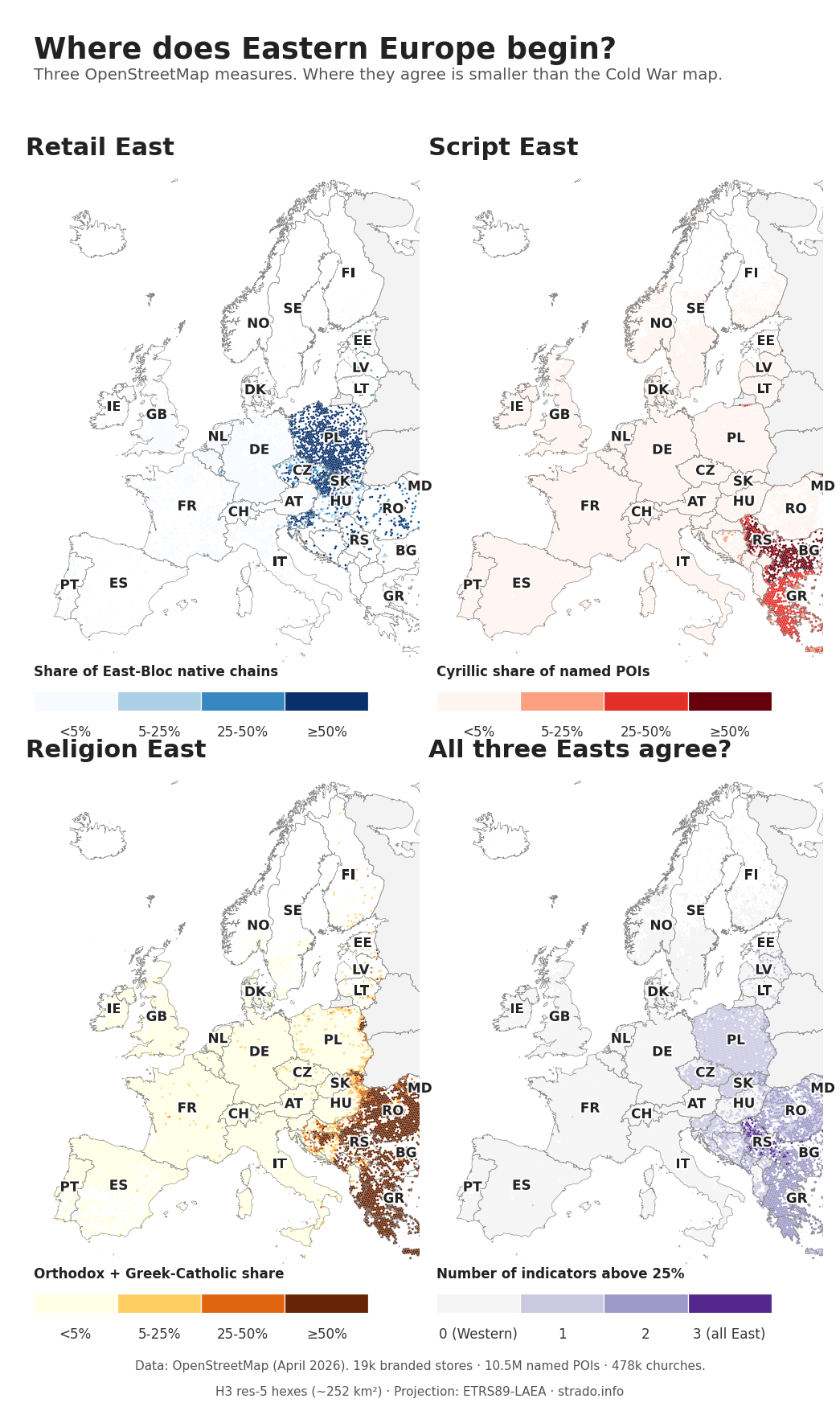
Stephen I of Hungary was crowned a Roman Catholic king in 1000 AD. Lithuania went Catholic in 1387. Estonia turned Lutheran in the Reformation. None of these countries ever used Cyrillic. The Cold War counted them all as Eastern Europe anyway.
On three OpenStreetMap measures of cultural geography (alphabet, church, retail chains), only four countries score East on all three: Bulgaria, Serbia, North Macedonia, southern Romania. Hungary, Czechia, Slovakia, Croatia, Slovenia, and the Baltics each score East on at most one.
The cultural line that pre-dates 1945 cuts further south and east than the Iron Curtain. Most of what the Cold War called Eastern Europe is, on the older measures, Central.
Why Hungary isn't really East
Stephen I, the first Christian king of Hungary, was crowned in 1000 AD with a crown sent by Rome. The country has been Roman Catholic for a thousand years, with a Calvinist minority that's also Western. Hungarian uses the Latin alphabet, always has, and Budapest's OSM POIs are 99% Latin. The native retail chains, CBA and Reál, are operationally indistinguishable from a French Carrefour or a German Edeka.
Hungary scores East on exactly one of the three measures: post-1991 retail, where domestic chains like CBA dominate outside the cities. On script and religion, it's Central. The 45 years between 1945 and 1990 don't show up in the cultural data, and that's the point. Hungarian identity sits a thousand years deep. Yalta sits 80.
The thick East
The brothers Cyril and Methodius arrived in Great Moravia in 863 AD to translate the liturgy into Slavonic. Their disciples, expelled by the Latin clergy, fled south to the First Bulgarian Empire. Out of that came the Glagolitic alphabet and, by the 890s, Cyrillic, named for one of the brothers. The Bulgarian Orthodox Church was established in 927.
A thousand years later, the descendants of that mission cluster the same way on the map. Sofia's OSM POIs are 69% Cyrillic, Skopje's 70%, Belgrade's 51%. Bulgaria, Serbia, North Macedonia and southern Romania all score East on alphabet, Orthodox or Greek-Catholic religion, and post-1991 native retail (Fantastico, T-Market, Maxi, Mercator). They're the only four countries where all three measures agree.
The Baltic anomaly
Lithuania converted to Roman Catholicism in 1387, in a deal called the Union of Krewo that put a Lithuanian on the Polish throne. It was the last European country to Christianise, and it went Latin. Latvia and Estonia turned Lutheran in the Reformation, with Riga adopting Lutheran reform in 1521. All three Baltic countries use the Latin alphabet, and all three have Catholic or Lutheran majorities.
They were Soviet republics from 1940 to 1991. That fifty-year window is the entirety of their Eastern Europe period; the rest is eight centuries of Western-aligned identity. Native retail chains (Maxima from Lithuania, Rimi from Latvia and Estonia, Selver from Estonia) all date to the 1990s, which is why retail-East fires for them. On the older measures it doesn't. Estonia, Latvia and Lithuania score East on one of three.
What the data doesn't see
The data sees scripts, denominations, and chain origins. It doesn't see how a Bulgarian and a Hungarian feel about Brussels, or how a Slovak teenager talks to a Croatian one online. It doesn't see the Cold War legacy of state-owned industry, secret-police archives, or the lustration laws that followed 1989. Cultural geography in the older sense is one layer. The political-economic East lives elsewhere, in regulatory style, GDP per capita, and how universities teach modern history.
The Cold War took a question, where does Eastern Europe begin, and answered it politically, with a wall. The wall came down 37 years ago. Hungary, Czechia, Estonia, Slovenia: they're not the same Eastern Europe as Bulgaria, Serbia, and North Macedonia. The data was already telling us that in 1990.